A short trip is a good opportunity to pack for actual events rather than every possible scenario. The challenge is often not clothing count but the volume of shoes, toiletries and items carried just in case. This workflow is for a three-calendar-day city weekend with two nights away. It does not assume any particular airline allowance. You will compare your finished bag with the rules for your own ticket after making the list.
Before you finish
- List all weekend events before choosing clothes.
- Set the worn outfit beside the items going into the bag.
- Check that containers close securely and are labelled.
- Measure the bag while packed, with expansion panels as used.
- Keep the final bag weight below your own entered limit with room to spare.
Make an event list first
List the journey, daytime walking, two evenings and the return. Then identify which events genuinely need different clothing. A casual restaurant visit may use the same clean top and bottom as the rest of the day, whereas a formal event may need a separate outfit. This event list is a better filter than the idea that every evening deserves another wardrobe. For each extra garment, name the event that requires it. If you cannot identify one, leave the garment beside the bag until the essential items have been packed and weighed.
Choose the worn outfit deliberately
The clothes you wear are part of the weekend kit. A versatile outer layer and your heavier everyday shoes can be worn during transit if they are comfortable for the journey. Do not use this as a reason to wear unsuitable layers or create an awkward airport routine. Lay the worn outfit next to the bagged outfits during your count. That visual check prevents packing a duplicate pair of trousers because the pair on your body has silently vanished from the inventory. All footwear must fit the real walking plan, not just the space available.
For the next input check, use Packing List Builder. Its result should retain the assumptions described here.
Reduce containers before removing useful contents
Full-size bottles and large toiletry cases can consume more room than a weekend requires. Decant only where the product and container are suitable, label containers clearly and keep the amount you realistically use. This is a volume decision, not advice about security rules; check the current restrictions for your airport and route. Avoid compressing everything into an unrecognizable collection of unlabelled containers. A compact kit that is easy to open and reclose is more useful than a slightly smaller kit that leaks or takes ten minutes to unpack.
Test the packed bag in ordinary use
Close the bag without forcing the zip, then carry it for a few minutes and access the item you would need first. If the bag has expandable panels, measure it in the exact configuration you will travel with. A bag that meets a size limit when empty can exceed it when stuffed. Leave a little room for food, a layer removed during transit or something acquired on the trip. That space is not wasted capacity; it prevents the return journey from becoming a second packing problem after a weekend that looked perfectly organized at home.
A related planning question is covered in How to calculate a travel laundry rotation.
A weekend with one formal event
Now change the example to a weekend containing a booked formal dinner. The packing decision is not automatically a second complete wardrobe. List the exact requirements of that event and compare them with the everyday pieces. A suitable top may combine with an existing bottom, while required footwear may be a separate item. If the second shoes are necessary, add their measured weight rather than continuing to quote the earlier 4.4 kg total. Place event clothing where it will not be damaged by other contents and consider whether it needs care on arrival. The remaining casual schedule can still use the compact base list. After the weekend, note whether the event kit served only that dinner or also covered another evening. This gives you a better reference for future short trips with a similar requirement. A trip-specific exception does not mean your ordinary weekend base is inadequate; it means the overlay needs a clear name and a distinct reason to exist.
Worked example
Worked example: Leo leaves Friday morning and returns Sunday evening. He starts with three days and no laundry. The default list includes four daily sets because it adds a spare. He decides that three tops plus the spare underwear and socks suit his activities, and removes one top after reviewing the itinerary. He wears the only shoe pair, packs one sleepwear set and adds a light rain layer. His empty bag weighs 1.3 kg; estimated contents weigh 3.1 kg. The weight tool shows 4.4 kg against his manually entered 7 kg allowance. This still says nothing about dimensions. Leo measures the closed bag and checks the ticket rules separately before treating the bag as ready.
Reference table
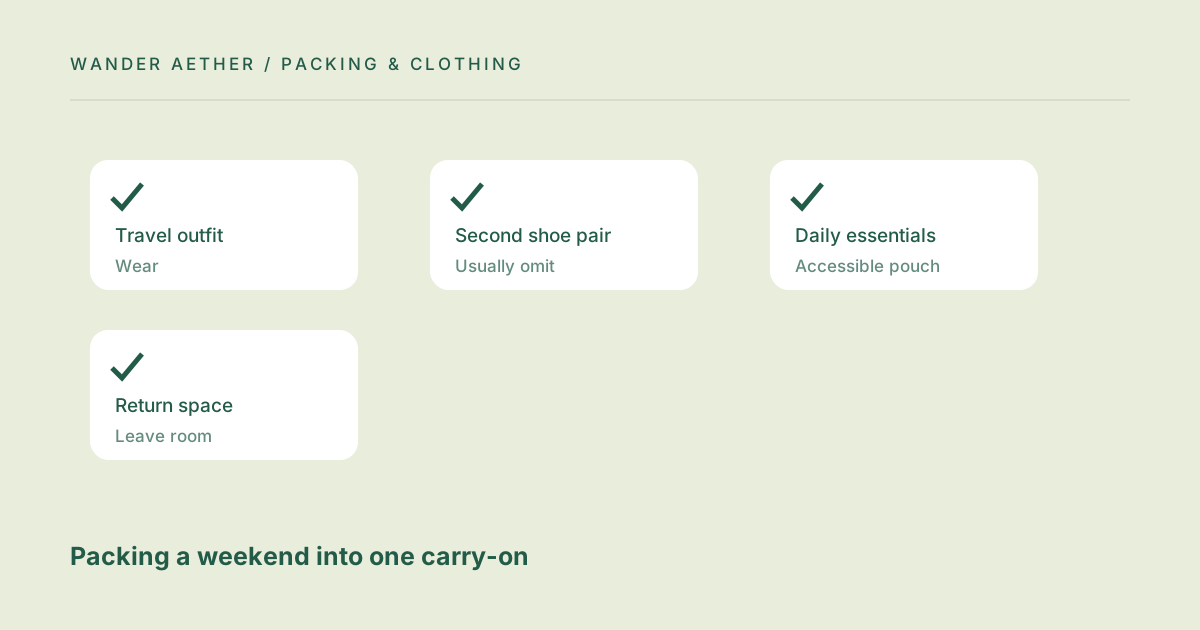
| Item or scenario | Value or choice | What to remember |
|---|---|---|
| Travel outfit | Wear | Count it within the clothing total |
| Second shoe pair | Usually omit | Add only for a distinct event or activity |
| Daily essentials | Accessible pouch | Avoid searching the main compartment |
| Return space | Leave room | Layers and purchases change the load |
Your next step
A weekend list should be easy to repeat with small changes. Save the successful list after the trip and record what you never used. On the next weekend, review those items against the new itinerary rather than removing them automatically. An unused rain layer and an unused third shoe pair may have very different reasons for being there.
Continue with Packing for warm and cold stops on the same trip. When your plan needs the next calculation, open Baggage Weight Estimator and carry over only the inputs appropriate to that tool.