Laundry changes packing quantity only when clean, dry clothes become available before the next outfit is needed. A washer somewhere near the hotel is not yet a laundry plan. The clothing calculator expresses this relationship as a rotation length, with a separate spare allowance. This guide explains the calculation so you can adjust it for interrupted schedules, hand washing or slow drying rather than treating a small clothing count as a universal target.
Understand the rotation formula
For a trip of D days and a usable laundry interval of L days, the base rotation is the smaller of D and L. With no laundry, the rotation is D. Add the chosen spare count to tops, underwear and socks. Bottoms use a separate rough reuse assumption: one for every three rotation days, rounded upward. The tool exposes this as a planning convention, not an instruction about how often everyone should change clothes. If your bottoms need daily replacement, override that count on your list. The daily-set calculation is the important relationship to understand.
Count when laundry becomes usable
Suppose you wash on the evening of day three but clothes take until the afternoon of day four to dry. The fourth morning still needs an already clean outfit. That arrangement may require a four-day rotation despite the wash happening on day three. Machines with drying facilities, accommodation access and weather all change the timing. Use the interval that describes your next usable clean set. If a laundry service promises a turnaround, confirm the collection schedule and whether that turnaround includes your actual drop-off time rather than the earliest possible drop-off.
For the next input check, use Clothing Rotation Calculator. Its result should retain the assumptions described here.
Use spares to cover a defined interruption
A spare set can cover one spill, an unexpected active day or a short delay in laundry access. It cannot reliably cover an indefinite failure of the washing plan. Write down what the spare is meant to absorb. If the only washer is unavailable for three days, a one-set buffer is not an adequate response. Decide whether to bring a longer rotation, book a laundry service or change the schedule. This makes the packing trade-off visible: more clothes increase bag volume, while fewer clothes require dependable time and facilities during the trip.
Different garments can have different cycles
The calculator keeps the interface simple by applying one cycle to daily tops, underwear and socks. Your actual kit may contain a quick-drying top that can be washed more frequently, a formal garment that is not washable during travel and outer layers that are rarely washed on a short journey. Keep those categories separate in your final checklist. Do not reduce every item just because one part of the wardrobe can dry overnight. Test any planned hand-washing routine before leaving, especially if the bag depends on using it on consecutive nights.
A related planning question is covered in Packing for warm and cold stops on the same trip.
What if you can wash only part of the kit?
Consider a trip where small items can be hand washed but heavier tops cannot dry quickly enough. A single common interval may overstate the laundry benefit for tops or understate it for underwear. Run the calculator twice to inspect the two cycles, then combine only the relevant category counts in your personal checklist. Label the shorter-cycle results as small-item counts so you do not accidentally apply them to every garment. Add the practical wash time and drying location to your notes. Test whether the accommodation permits the method and whether you can leave items drying while away. This partial-laundry approach is useful when it reflects a routine you have actually tested. It is fragile when every evening must go perfectly to provide tomorrow's only clean set. Keep a buffer appropriate to the interruption you can tolerate, and do not reduce non-washable event clothing simply because the small-item cycle works. The exported calculator result is a starting calculation; your combined category list is the final plan.
Worked example
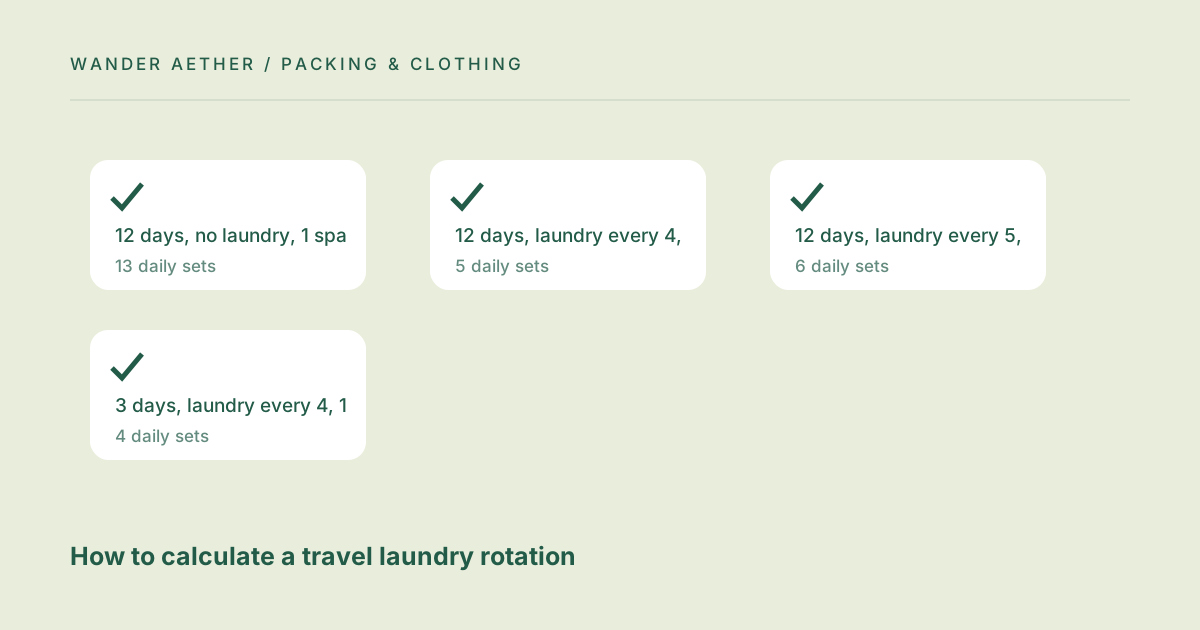
Worked example: A twelve-day trip includes reliable laundry after days four and eight. Enter twelve days, four days between laundry and one spare. The calculator returns five tops, underwear and sock sets, two bottoms and two planned wash sessions. Now move laundry to every five days: the daily sets rise to six, while the number of sessions remains two. Enter zero for laundry and the result becomes thirteen daily sets with no wash sessions. Those outcomes reveal three different travel experiences, not three competing ideals. The five-set version asks for a dependable four-day wash rhythm; the no-laundry version gives more independence at a clear cost in volume and weight.
Reference table
| Item or scenario | Value or choice | What to remember |
|---|---|---|
| 12 days, no laundry, 1 spare | 13 daily sets | No dependency on washing |
| 12 days, laundry every 4, 1 spare | 5 daily sets | Two usable wash opportunities |
| 12 days, laundry every 5, 1 spare | 6 daily sets | Longer rotation with two washes |
| 3 days, laundry every 4, 1 spare | 4 daily sets | Trip ends before a wash is required |
Before you finish
- Choose an interval based on clean-and-dry availability.
- Keep the spare count separate from ordinary rotation days.
- Adjust bottoms if the reuse assumption does not fit.
- List non-washable event clothing independently.
- Recalculate when an accommodation or laundry schedule changes.
Your next step
Record the laundry dates alongside the packing list. A clothing total without the schedule that supports it is difficult to review later. After the trip, note whether the planned interval actually worked and which fabrics caused trouble. Those observations are more valuable for the next calculation than a generic rule to pack less.
Continue with A family packing system that avoids shared-item gaps. When your plan needs the next calculation, open Baggage Weight Estimator and carry over only the inputs appropriate to that tool.