Removing ten tiny items may save less weight than reconsidering one spare shoe pair. A weight inventory makes this visible and helps you focus on changes with a meaningful effect. The aim is not to make every bag as light as possible. It is to keep useful coverage while meeting your travel constraints. This guide uses measured contributions to compare substitutions, shared items and clothing rotations without treating all grams as equally dispensable.
Worked comparison
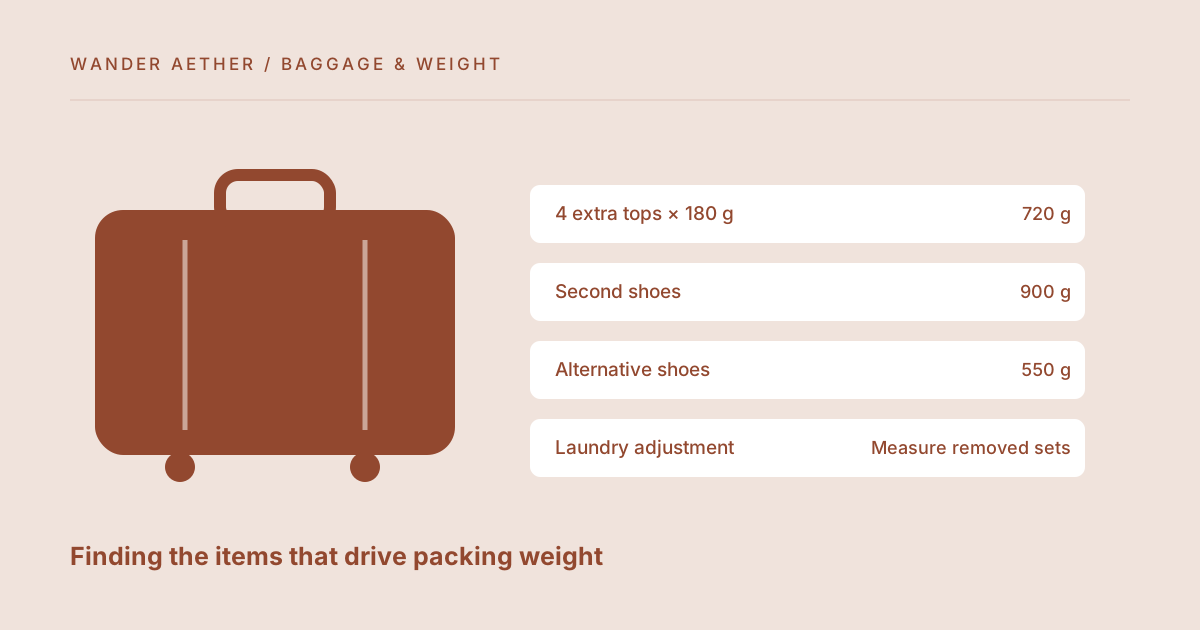
Worked example: Four extra tops at 180 g each add 720 g. A second shoe pair adds 900 g. Replacing that pair with a measured 550 g option saves 350 g; removing it completely saves 900 g but also removes its function. A reliable shorter laundry rotation could remove three tops and three underwear items, producing another measured saving. The traveler compares those options with the itinerary: the shoe pair is required for a booked event, while laundry is confirmed at the accommodation. She keeps the shoes and adjusts the clothing rotation, then checks the new total including the laundry kit.
Calculate contribution, not just item weight
Multiply grams per unit by quantity to see each row's total. A light top repeated eight times may contribute more than one heavier accessory. Conversely, a heavy outer layer may be necessary for the trip. Review row totals and the empty-bag weight before making cuts. The calculator shows total weight; your source inventory gives the row-level detail. If a row groups several unlike items, split it so you can identify the actual contributor. A category called extras is too vague to support a sensible removal decision.
For the next input check, use Baggage Weight Estimator. Its result should retain the assumptions described here.
Ask what function would be lost
For each large contribution, name its use and decide whether another packed item covers that use adequately. A second shoe pair may be redundant on one city weekend but required for a distinct event on another trip. A charging device may support essential work rather than optional entertainment. Do not remove an item solely because it is heavy. Compare weight with the inconvenience or risk of lacking its function. This question keeps the inventory connected to the itinerary instead of turning a numerical target into a reason to undermine the trip.
Test substitutions with measured differences
If an alternative item saves weight while serving the same purpose, calculate the difference using actual measurements. Replacing a 900 g item with a 550 g alternative saves 350 g; it does not save the full 900 g. Include any extra accessories required by the substitute. A lighter device that needs a separate adapter may offer less saving than expected. Recalculate the full inventory after the substitution. The exported total becomes a new version of the plan, so retain enough notes to remember which item is represented by each row.
A related planning question is covered in Estimating bag weight from an item inventory.
Use laundry as a system change
Reducing daily clothing through laundry can produce a substantial saving, but it adds time and facility dependencies. Use the clothing calculator to compare rotations, then multiply the changed quantities by your garment weights. Include any laundry supplies in the inventory. If the savings matter only when every wash works perfectly, decide whether that dependency is acceptable. A spare can still be justified. The most useful decision is a measured trade-off between weight, time and flexibility, not a claim that a particular small clothing count is best for everyone.
A removal decision with a clear stop condition
Set a practical target based on the entered constraint and your preferred margin, then stop reducing once the plan meets it without unnecessary compromise. Otherwise a weight review can turn into an endless contest to remove useful belongings. Suppose you need to save 500 g. A 600 g optional accessory might solve that problem alone, while deleting five personally useful small items produces only 200 g and more inconvenience. Compare the measured saving with the function lost and the target still unmet. Keep any replacement weight in the calculation. If every remaining heavy item has a necessary role, consider a different bag arrangement or travel plan rather than pretending the inventory can shrink indefinitely. The calculator is valuable because it makes the boundary visible. It does not decide how much convenience you should sacrifice. A successful revision meets the real constraint, preserves the activities you chose and leaves a clear explanation of the one or two changes that produced the useful saving.
Reference table
| Item or scenario | Value or choice | What to remember |
|---|---|---|
| 4 extra tops × 180 g | 720 g | Quantity can dominate |
| Second shoes | 900 g | Review distinct use |
| Alternative shoes | 550 g | 350 g saving, not 900 g |
| Laundry adjustment | Measure removed sets | Adds schedule dependence |
Before you finish
- Multiply unit weights by quantities before ranking contributors.
- Split vague grouped rows into identifiable items.
- Name the function of every proposed removal.
- Measure substitutions including required accessories.
- Account for laundry supplies and timing when reducing clothes.
Your next step
Save both the original and revised inventory when the trade-off is significant. After traveling, compare use with weight: a heavy item used every day may have earned its place, while a lighter duplicate never used may be the better candidate next time. Practical value should remain the deciding measure.
Continue with Checking a carry-on limit: weight is only one requirement. When your plan needs the next calculation, open Clothing Rotation Calculator and carry over only the inputs appropriate to that tool.