A packing list counts items; a weight inventory measures what those items contribute to a bag. The baggage tool accepts an empty-bag weight in kilograms and item rows in grams per unit with a quantity. It sums the contents and compares the packed estimate with the allowance you enter. This is a useful preparation step, but the final bag still needs a physical weighing because containers, cables and last-minute additions are easy to miss.
Weigh the bag before adding contents
An empty suitcase or backpack can consume a substantial part of the allowance. Measure it in the configuration you will use, including removable straps or organizers if they stay attached. Enter that measurement in kilograms. Do not add the same empty bag as an item row, because the tool would count it twice. If you cannot measure it yet, mark the estimate in your private notes and replace it before departure. Manufacturer specifications may describe a different configuration, so direct measurement is preferable when a weight margin is small.
Create one row per repeatable item type
Use Item, grams each, quantity. A row such as Tops, 180, 4 contributes 720 g. If garments differ substantially in weight, separate them rather than treating a heavy outer layer like an ordinary top. Include the container around toiletries and electronics, not just the product or device. The row format uses commas as separators, so avoid commas inside item names. The parser validates positive whole quantities and nonnegative item weights, but it cannot tell whether your measurements represent the real items you plan to carry.
For the next input check, use Baggage Weight Estimator. Its result should retain the assumptions described here.
Keep worn and carried items in the correct scope
The packing builder includes worn clothing in its suggested wardrobe totals. A bag-weight inventory should include only the items that are actually inside the bag being checked. If you wear the heavier shoes, exclude them from that bag estimate unless you intend to pack them later. Personal-item bags may have separate limits or may count together with a cabin bag depending on the ticket rules. The tool compares one inventory with one entered allowance; it does not decide how an airline combines or separates your bags.
Leave room for measurement error and additions
The result below an allowance is a numerical margin, not an acceptance guarantee. A scale may have limited resolution, and a small discrepancy can matter near the limit. Add likely travel-day contents such as a charger moved from the desk, a water container in the state you will carry it and purchased items if applicable. Then weigh the closed bag directly. Dimensions and permitted contents require their own checks. The inventory is valuable because it shows which items create weight, not because it replaces the rules or the physical scale.
A related planning question is covered in Finding the items that drive packing weight.
Finding why the scale and inventory disagree
If the physical packed weight differs materially from the estimate, do not immediately adjust the empty-bag field to force a match. Recheck the inventory scope first. Common omissions are organizers, toiletry containers, charging accessories, items in outer pockets and contents added after the list was measured. Also confirm that unit weights were not entered in kilograms where the row expects grams. A measured packed cube may have been counted again through its separate garment rows, creating an overestimate instead. Reconcile the difference item by item and record any unavoidable scale resolution in your notes. Once the list reflects the actual bag, its what-if calculations become more useful. An arbitrary correction factor hides the source of the discrepancy and can fail when you change items. The goal is a transparent inventory close enough to support decisions, followed by a final direct weighing. If the remaining margin is smaller than the measurement uncertainty, treat the result cautiously and create more room rather than relying on the displayed decimals.
Worked example
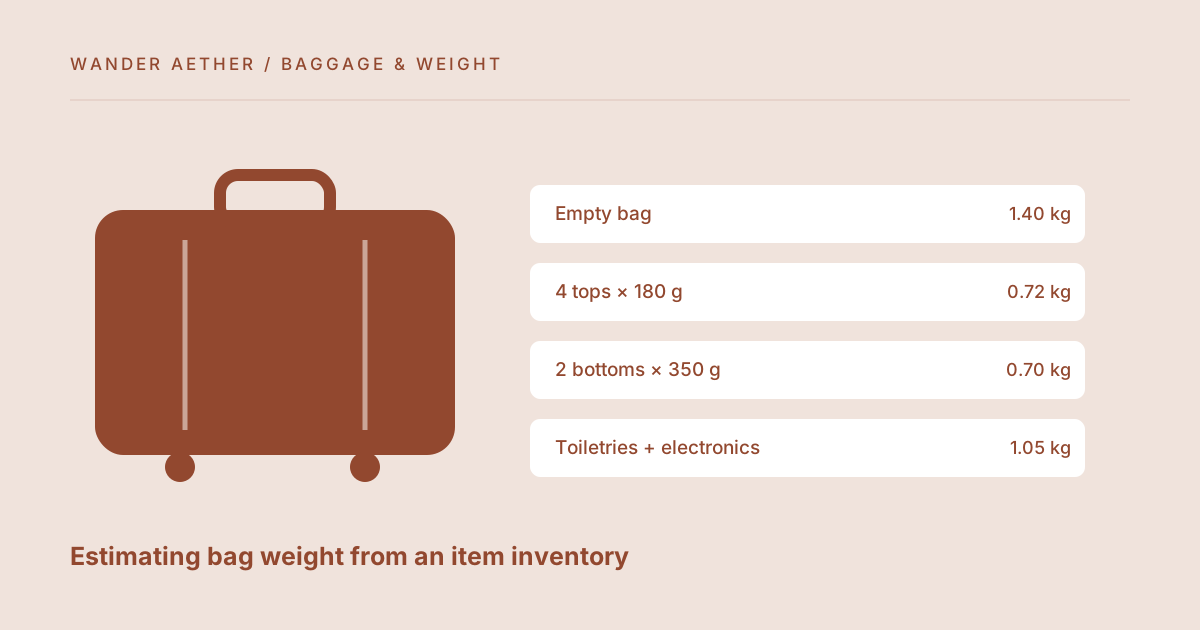
Worked example: An empty bag weighs 1.4 kg. Four tops at 180 g contribute 720 g; two bottoms at 350 g contribute 700 g; a toiletry kit weighs 450 g; electronics total 600 g. Contents add to 2.47 kg and the packed estimate is 3.87 kg. Against an entered 7 kg allowance, the tool reports 3.13 kg remaining. This margin changes if a 900 g second shoe pair is added. The traveler can now discuss a specific trade-off rather than guessing why the bag feels heavy. The final physical weight and dimensions still need verification against the actual booking.
Reference table
| Item or scenario | Value or choice | What to remember |
|---|---|---|
| Empty bag | 1.40 kg | Entered separately |
| 4 tops × 180 g | 0.72 kg | Repeated item row |
| 2 bottoms × 350 g | 0.70 kg | Repeated item row |
| Toiletries + electronics | 1.05 kg | Include containers |
| Packed estimate | 3.87 kg | Bag plus contents |
Before you finish
- Measure the empty bag in its travel configuration.
- Enter item weights in grams and bag weight in kilograms.
- Separate unusually heavy garments from ordinary daily items.
- Exclude worn items from the bag being calculated.
- Weigh and measure the finished bag before departure.
Your next step
A good inventory supports decisions: removing or replacing one row has a visible effect. Save it with your packing checklist and update the measurements after the trip. Over time, your own measured kit becomes a more reliable planning reference than any generic average item weight.
Continue with Packing cubes: organization, volume and added weight. When your plan needs the next calculation, open Clothing Rotation Calculator and carry over only the inputs appropriate to that tool.
Compare an estimate with a real scale
This sample inventory uses measured item weights and a hypothetical 7 kg planning limit. The limit is an input for comparison and says nothing about any airline or ticket.
| Inventory line | Calculation | Mass |
|---|---|---|
| Empty bag | 1.20 kg | 1.20 kg |
| Four clothing bundles | 4 × 450 g ÷ 1000 | 1.80 kg |
| Toiletries and electronics | (600 g + 900 g) ÷ 1000 | 1.50 kg |
| Estimated packed total | 1.20 + 1.80 + 1.50 | 4.50 kg; estimated margin 2.50 kg |
| Scale reads 4.75 kg | 4.75 − 4.50 = 0.25 kg difference | Find omitted containers or items; measured margin is 2.25 kg. |
Make your own decision record
Bag identifier: ___
Empty bag kg: ___
Item / quantity / grams per unit: ___
Contents grams ÷ 1000: ___
Estimated total kg: ___
Measured packed kg: ___
Difference and explanation: ___
Applicable limit and booking source: ___
Margin using measured total: ___
Dimensions / separate bag rules checked: ___
Download example and blank worksheet (.txt)
A plain-text file you can edit or print. No account or upload is needed.