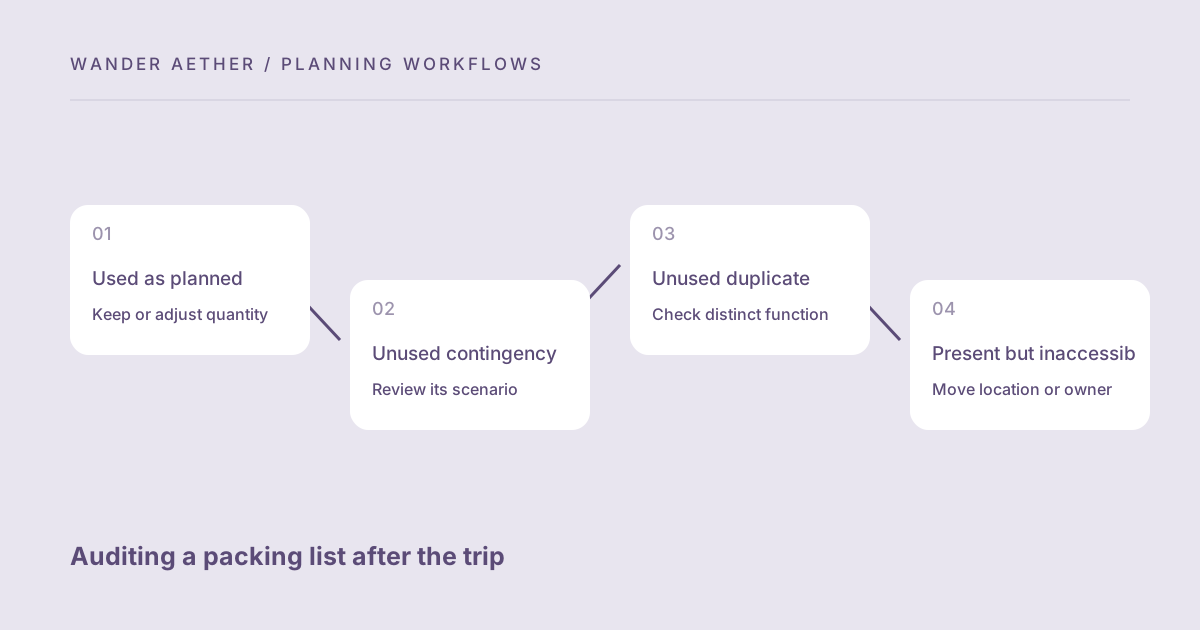
The best time to improve a packing system is while the trip is still easy to remember. A post-trip audit identifies missing items, unhelpful duplicates and assumptions that worked or failed. It should not reduce the next list by deleting everything unused. Some items are reasonable contingencies, and a different climate or activity changes their value. This guide turns your exported checklist into a practical evidence record for future trips.
Before you finish
- Mark actual use while the trip is fresh.
- Record unused quantity, not only unused categories.
- Write down laundry timing that really worked.
- Review access and ownership failures.
- Keep base essentials separate from climate and activity overlays.
Record use before putting everything away
Mark each line as used, not used, needed but absent or used differently than expected. Add a brief note for anything that caused inconvenience. Quantity matters: you may have used tops from a category but still brought several too many. Record the maximum clean rotation actually needed between usable washes. This observation links directly to the clothing calculator and helps distinguish a successful laundry plan from an optimistic one. Do not rely on memory a month later, when the main impression may be simply that the bag felt heavy.
Separate contingency from duplication
An unused spare set may have served a sensible role as insurance against a spill or laundry delay. An unused duplicate charger may have had no distinct access need. Ask what condition would have required the item and whether that condition was plausible on the trip. This is a decision review, not a rule that every item must earn its place by being used. Record the reason before removing a contingency. For a future trip with different weather, transport or accommodation, the same reason may justify keeping or adding it.
For the next input check, use Packing List Builder. Its result should retain the assumptions described here.
Review access failures as well as omissions
An item can be present and still fail to help because it is in the wrong bag or owned by someone who is elsewhere. Note when you had to unpack deeply at arrival, borrow a shared item or wait for another traveler. These are packing-location problems rather than quantity problems. Adjust the grouping or responsibility before buying another copy. A small accessible pouch may solve the issue at less weight than duplication. The family responsibility guide is useful even for two adults because shared-item assumptions can break in small groups too.
Build a reusable base with trip-specific overlays
Keep a short base list of personal essentials and tested everyday equipment. Store climate, activity and laundry adjustments separately so the next list is not a copy of the previous trip with its special assumptions hidden. The packing builder can regenerate the broad quantities for new days and conditions; your audit supplies the personal corrections. If a favorite garment wore poorly or dried too slowly, record that item-specific experience in the inventory. A reliable system improves through observation, not by becoming a permanently longer list of every possible thing.
A related planning question is covered in Planning a sightseeing day for a mixed-pace group.
Distinguishing a quantity error from a schedule error
Running out of clean clothing does not always mean you packed too little. It may mean the planned laundry session happened later than expected or the drying assumption failed. Record the timeline before increasing every garment count. If the same reliable wash interval will be available next time, a different fabric or an earlier drop-off may solve the problem. If access was fundamentally uncertain, a longer base rotation is the honest correction. Conversely, returning with several untouched daily sets may mean the rotation was overestimated, or that an intended active day never happened. Compare actual activities with planned ones before reusing the lower quantity for another trip. This review keeps the audit causal: the change should address the reason the list performed as it did. Otherwise the base list grows after every inconvenience and shrinks after every unused item, without learning which assumptions were wrong. Save a short cause-and-change note beside the affected line so the next packing decision remains understandable.
Worked example
Worked example: After a seven-day trip, a traveler notes that the five-set rotation worked because laundry finished on day four. Two bottoms were both used; a second shoe pair was never needed; the light rain layer was unused but matched a reasonable weather contingency. The charging cable was used daily but difficult to reach on arrival. For the next comparable trip, she removes the spare shoe pair, keeps a weather review step instead of automatically deleting the rain layer and moves the cable into the arrival pouch. A trip without confirmed laundry will still need a longer clothing rotation despite this successful audit.
Reference table
| Item or scenario | Value or choice | What to remember |
|---|---|---|
| Used as planned | Keep or adjust quantity | Example: daily charging cable |
| Unused contingency | Review its scenario | Do not delete automatically |
| Unused duplicate | Check distinct function | Possible weight reduction |
| Present but inaccessible | Move location or owner | Quantity may already be correct |
Your next step
Your improved list should be shorter where evidence supports a reduction and clearer where uncertainty remains. Keep the audit private and local, just like the original packing output. On the next trip, review the new itinerary first and then reuse the tested parts of the system.
Continue with A practical sequence for dates, packing, budget and daily plans. When your plan needs the next calculation, open Travel Time Zone Converter and carry over only the inputs appropriate to that tool.