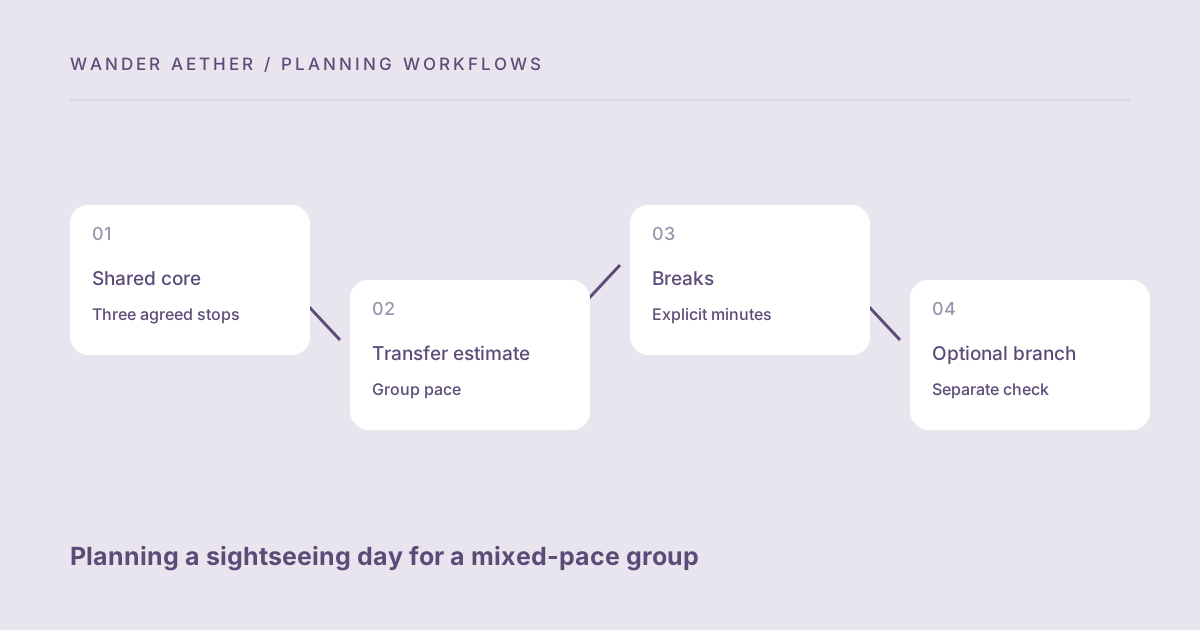
A group itinerary should reflect the pace people are willing and able to use, rather than the fastest person's estimate. Different interests, luggage, photography stops and preferences for breaks can change the time needed at the same place. The pace tool works with a single set of time assumptions, so the useful task is agreeing on those assumptions and testing alternatives before the day begins. This is logistical planning, not a personal fitness assessment.
Use realistic group transfer times
Estimate movement for the group as it actually travels, including gathering people, finding entrances and handling ordinary navigation. A map's fastest walking estimate may not reflect a relaxed sightseeing group. Use route information as a starting point and add the relevant practical allowance explicitly. Avoid assuming that a slower traveler will simply catch up at every stop. If different paces require a split, plan the reunion location and time clearly. A split group is a new itinerary arrangement, not just a smaller transfer-time input.
For the next input check, use Itinerary Pace Calculator. Its result should retain the assumptions described here.
Create a simple split or fallback option
When interests differ strongly, one optional branch may work better than asking everyone to visit everything. Specify a recognizable meeting point, local date and time, and a fallback if a participant is delayed. Each branch needs its own time check; the group's main calculation does not automatically validate both. Avoid dependence on a single inaccessible shared item when people separate. This is where family packing responsibilities and itinerary planning connect: access to chargers, documents and other essentials should still make sense after the group splits.
A related planning question is covered in How much itinerary buffer does a travel day need?.
Review the first day before repeating its assumptions
If the first sightseeing day takes longer than expected, identify which category changed. Perhaps visits were enjoyable and naturally longer, or transfers took more time because the group paused frequently. Update that category for subsequent days instead of applying an unexplained extra hour to every plan. If some people prefer to split for one stop, incorporate a clear reunion rather than describing the group as slow. The tool has no personal profiles and does not assess anyone's capability; it uses the times the group agrees to plan around. A brief evening review can make the rest of the itinerary more realistic without turning the trip into continuous measurement. Ask which shared priorities were successful, which optional stops were dropped and whether breaks occurred as intended. Then revise the next day's core and transfer assumptions. A good group plan responds to observed preferences, not just to the original spreadsheet. Keep the adjustments simple enough that everyone can understand what changed and why.
Worked example
Worked example: Four travelers have seven available hours. Their combined wish list has five stops at fifty minutes each, six transfers at twenty minutes and seventy minutes of breaks. Base time is 440 minutes, already above the 420-minute window before any buffer. They choose three shared core stops instead. That revised base is 340 minutes, and a 15% buffer brings it to 391. One traveler has an optional nearby fourth stop while others take a longer break, with a confirmed reunion point. Both branches are checked separately and the optional visit is dropped if the earlier core runs late.
Reference table
| Item or scenario | Value or choice | What to remember |
|---|---|---|
| Shared core | Three agreed stops | Protect common priorities |
| Transfer estimate | Group pace | Include gathering and access |
| Breaks | Explicit minutes | Avoid silent removal |
| Optional branch | Separate check | Use a clear reunion plan |
Before you finish
- Choose common priorities before combining all wish lists.
- Estimate transfers for the actual group rhythm.
- Agree which breaks belong in the shared core.
- Validate optional branches separately.
- Keep essential personal access when the group splits.
Your next step
A good group day leaves people with a shared understanding of what can change. Export the time budget, then add the priorities and fallback notes because the calculator cannot express preferences. Revisit those assumptions after the first day rather than forcing the rest of the trip to follow estimates that proved unrealistic.
Continue with Auditing a packing list after the trip. When your plan needs the next calculation, open Travel Time Zone Converter and carry over only the inputs appropriate to that tool.