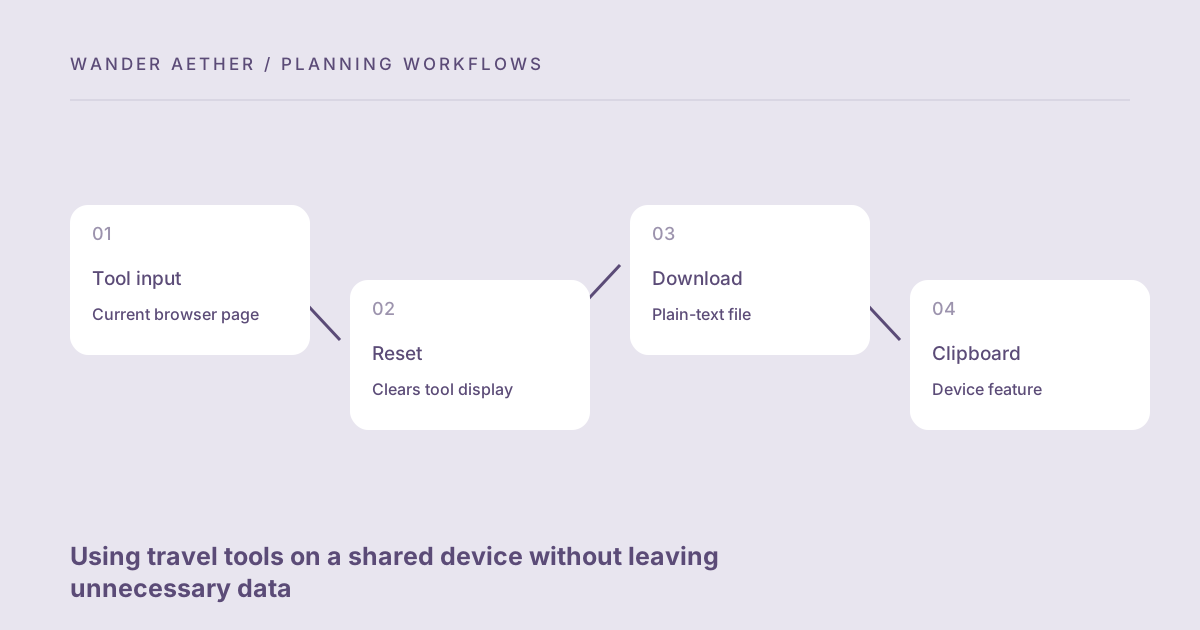
A browser-based tool can process inputs locally and still leave traces through downloads, clipboard contents or a browser session. Wander Aether does not send tool input to an application backend and does not automatically save your packing or payment entries. That reduces unnecessary collection, but it does not make a shared computer a private environment. This guide explains what local processing means here and how to use the tools with only the information they require.
Enter the minimum information needed
Packing requires counts and trip conditions, not passport numbers or booking references. Currency needs an amount, a manual rate and optional labels, not bank details. The expense splitter needs identifiable names within your group and payer totals, not account numbers. Avoid adding sensitive data to free-text fields just because the tool accepts text. Local computation is useful precisely because the calculation can work with these small inputs. The privacy policy explains the site's own behavior; your browser, extensions, device administrator and hosting environment are separate parts of the overall context.
What offline use does and does not require
Once a tool page and its local scripts have loaded, the calculation itself does not need a rate server, map service or application backend. However, this initial site does not include a service worker that guarantees every page is cached for later navigation. Opening a new guide without a connection may fail even if a previously open tool still calculates. A complete local download served through a local static server is another option, but that is a separate deployment workflow described in the README. Do not interpret client-side calculation as a promise of automatic offline availability. Copy and download functions also depend on browser behavior and permissions, though text download ordinarily uses only the local result. This distinction is useful before relying on a tool during a journey with uncertain connectivity. Prepare the needed pages or export the results while online, and keep essential booking information in your own reliable travel records. The site supplies local arithmetic, not an emergency access or document-storage system.
For the next input check, use Packing List Builder. Its result should retain the assumptions described here.
Understand the page-session behavior
The tools keep results in the current page and do not use localStorage or cookies for automatic list persistence. Reloading or leaving the page may lose your entries. Browser features can still restore pages, autofill fields or retain form values in ways controlled by the browser. Do not depend on those features as a reliable save method, and do not assume closing a tab erases every device-level trace. If you need a durable record, use the explicit download function and choose where the file should live under your normal device practices.
Treat exports and clipboard as separate records
Copying a result places text on the device clipboard if permission is available. Other applications or clipboard managers may retain it. Downloading creates a plain-text file outside the page, and that file can contain traveler names or financial totals you entered. The tool cannot delete those external records for you. On a shared device, avoid copying or exporting information you do not want others to access. If an export is needed, follow the device's ordinary file-handling and sign-out practices rather than assuming a browser reset button manages downloaded files.
A related planning question is covered in A practical sequence for dates, packing, budget and daily plans.
Review changes when external services are added
The initial site has no analytics, advertising or embedded third-party widgets, and its assets are served locally. A hosting provider may still keep request logs such as IP address and requested paths. If the owner later adds analytics, ads or other services, the privacy and cookie pages need to describe the actual new processing and any required controls. An ads configuration flag alone is not a consent system. For a user, the practical habit is to reread relevant privacy information after a site's behavior changes rather than relying indefinitely on an old description.
A case to check
Worked example: A group prepares an equal-share settlement on a borrowed laptop. They enter short first names and total shared amounts, leaving account numbers out. They view the transfers and agree to use their own payment applications separately. If they download the settlement, they understand that the text file now exists outside the browser page. Pressing Reset clears the displayed tool result but does not delete that file or clear another application's clipboard history. For a packing list they can enter only duration, climate and counts, so no personal itinerary identifiers are necessary at all.
Reference table
| Item or scenario | Value or choice | What to remember |
|---|---|---|
| Tool input | Current browser page | No application-backend submission |
| Reset | Clears tool display | Not a device cleanup function |
| Download | Plain-text file | User controls external storage |
| Clipboard | Device feature | May persist outside the page |
| Hosting requests | Server environment | Logs depend on provider |
Before you finish
- Use counts and labels instead of sensitive identifiers.
- Expect page-session entries to be lost without explicit export.
- Treat downloaded text as a separate private record.
- Consider clipboard behavior on shared computers.
- Review the policy if external services are introduced later.
Your next step
Local processing is a concrete feature with a limited scope: the travel calculation happens in your browser. It is not a promise about every component of a device or hosting service. Read the privacy and cookies pages for this site's current behavior, and keep your input as small as the task allows.
Continue with Why a packing checklist disappears after reloading. When your plan needs the next calculation, open Travel Time Zone Converter and carry over only the inputs appropriate to that tool.