Build an Indoor Alternative Without Doubling the Itinerary
Create one decision point and a complete substitute plan instead of stacking backup activities onto the original day.
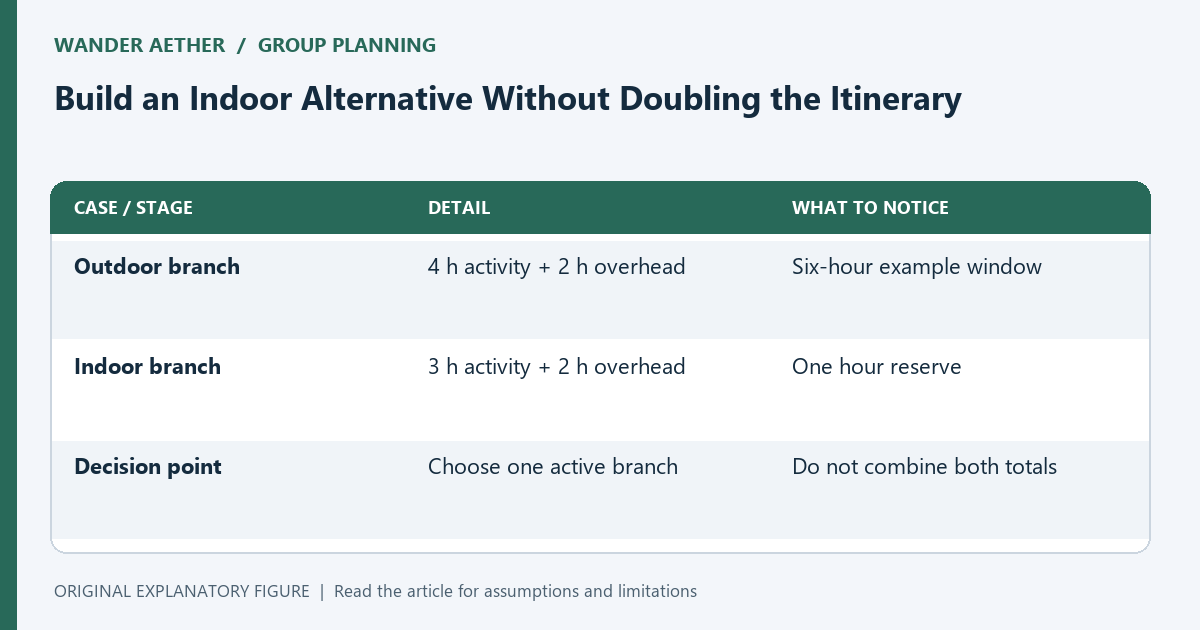
A weather or access backup can accidentally become an extra set of commitments rather than an alternative. A usable branch replaces the affected part of the day and preserves shared constraints. This guide builds an illustrative outdoor/indoor choice. It does not verify any attraction’s current hours, weather forecast, or booking conditions; check those when selecting real activities.
Identify what can force the branch
Name the condition that changes the plan: unsuitable weather, a closure, or a transport disruption. Choose a decision point before the affected activity. Avoid an unclear instruction to “see how it goes” when the choice requires a booking or a long transfer.
Separate confirmed commitments from optional ones. A backup should preserve necessary meals, transport, and return arrangements. Write which part of the original day it replaces so the group does not attempt both versions.
Give the alternative a full time budget
Include access, the activity, meals when relevant, and return travel. An indoor venue with a short visit can still require a long journey. Use the same budget categories as the outdoor branch.
In an invented six-hour window, one branch might use four hours of activity and two hours of overhead. Another might use three hours of activity, two of overhead, and one of reserve. Both fit without stacking their activity totals.
Verify actual conditions separately
Check current opening hours, access requirements, and reservation or cancellation conditions for the real choices. A backup with unavailable tickets is not a usable alternative. Keep the source and date of the check in your planning note.
Do not purchase incompatible commitments without understanding their conditions. This generic branch method cannot determine the financial or contractual consequences of a particular booking. Make those decisions from the relevant provider information.
Share a clear decision rule
Write who checks the condition, when the decision is made, and how everyone learns the selected branch. Use your normal group communication to agree on it. The plan should have one active version after the choice.
Keep the meeting point and return constraint explicit in both branches. If those differ, label the difference clearly. A backup that changes the location silently can create more coordination trouble than the original uncertainty.
Review the selected branch as a normal day
Once chosen, inspect the actual sequence for travel, meals, and usable time. Remove the inactive branch from the immediate view while retaining it in the planning record. That keeps the day easy to follow.
Use the itinerary-pace tool to compare each branch separately. After the trip, note which assumption mattered most. A good alternative is a complete replacement with a decision point, not an additional list that makes an already busy day twice as long.
| Case or stage | Detail | What to notice |
|---|---|---|
| Outdoor branch | 4 h activity + 2 h overhead | Six-hour example window |
| Indoor branch | 3 h activity + 2 h overhead | One hour reserve |
| Decision point | Choose one active branch | Do not combine both totals |