Audit a Packing List by Failure Cost and Replaceability
Review a small bag by what happens if an item is missing, how easily it can be replaced, and whether it duplicates another item.
A packing checklist can become longer every time you imagine another inconvenience. An audit helps you distinguish an essential item from a duplicate that solves a low-cost problem. This guide offers a practical comparison method without making claims about destination availability. Verify local conditions and any required documents or equipment for your actual trip.
Start with functions
Write what an item does: access a booking, charge a device, provide a dry layer, or carry a required document. Two items may serve the same function, while a small adapter may enable several important functions.
Group items by function before removing anything. The question is not whether an object looks unnecessary on its own, but whether the bag still supports the activity after you remove it. Keep required and personally necessary items outside a casual “pack lighter” contest.
Describe the failure cost
For each optional item, write a concrete consequence of omission. “Need to buy another pen” differs from “cannot charge the device that holds the booking.” Do not use a vague high/low score without the explanation.
Consider dependencies. A spare cable is useless if the only charger fails, and a charger may be useless without the right power setup. Review the whole chain for an important function rather than multiplying backups for only its easiest component.
Check replaceability rather than assuming it
An inexpensive item at home may be difficult to replace during a remote stay or an early transfer. A bulky item might be readily available at the accommodation. Put “verified,” “assumed,” or “unknown” beside replacement availability.
For real decisions, confirm the relevant information with the provider or a current local source. This article cannot tell you what a particular shop stocks. When availability is unknown and failure would be costly, treat that uncertainty explicitly instead of using a confident guess.
Measure the duplicates
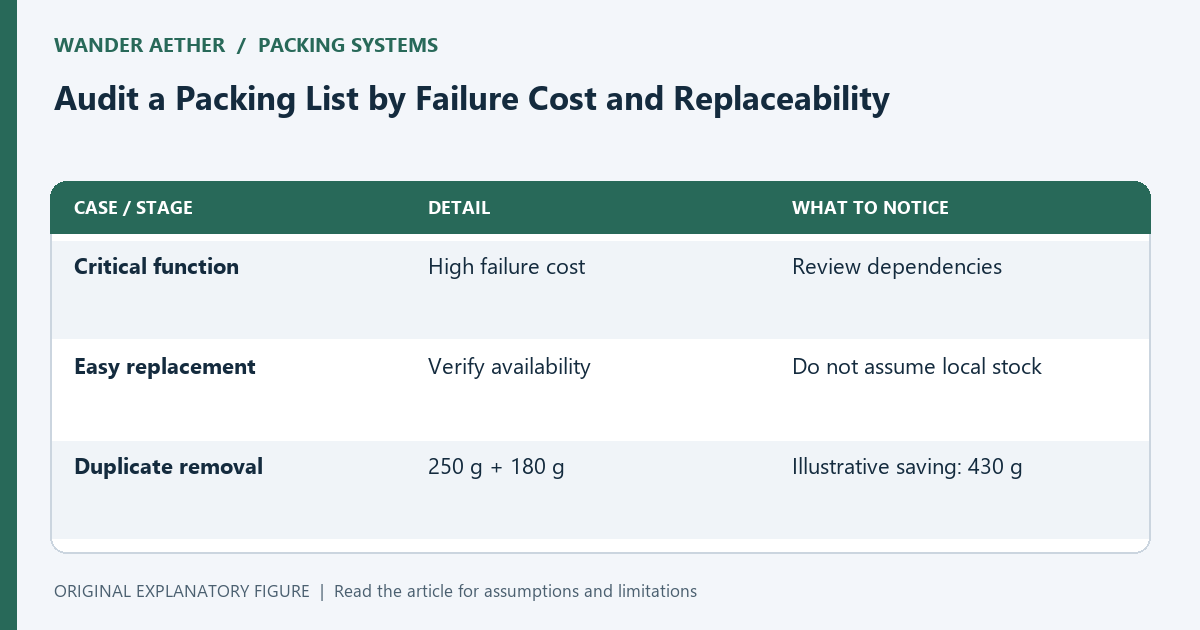
Weigh duplicate items and compare the functions they preserve. In an invented audit, removing a 250-gram spare notebook and a 180-gram duplicate pouch saves 430 grams. Keeping a 35-gram spare cable may be reasonable if it protects a critical charging function.
Those weights are examples. Measure your own items and check whether the proposed removal changes organization or protection elsewhere. Saving weight in one category can create a problem if it forces another item into an unsuitable place.
Finish with a rehearsal
Pack the revised list and simulate one transfer: reach documents, take out a layer, and connect the charger. If an essential item is hard to access, move it rather than automatically adding another organizer.
Use the baggage-weight tool to total the real inventory and the packing list to record the decision. After the trip, note which omission caused a problem and which duplicate went unused. Review the evidence next time; avoid turning one unusual event into a permanent rule for every destination.
| Case or stage | Detail | What to notice |
|---|---|---|
| Critical function | High failure cost | Review dependencies |
| Easy replacement | Verify availability | Do not assume local stock |
| Duplicate removal | 250 g + 180 g | Illustrative saving: 430 g |