Plan the Hours Between Arrival and Accommodation Access
Separate arrival, luggage access, and check-in assumptions before filling the first day with activities.
An early arrival does not automatically provide an empty day for sightseeing. You may need to handle bags, reach the accommodation, and wait for confirmed access. This guide builds an illustrative first-day plan from those conditions. It does not state any property’s current check-in or storage policy; verify those details directly for your booking before relying on them.
Record the confirmed access time
Write the arrival time and the accommodation access time separately. A booking date alone does not establish that a room is available at the moment you reach the property. Check what is confirmed and what is merely requested.
If early access is uncertain, keep it as an optional benefit rather than the core plan. Use the property’s current instructions for check-in and luggage handling. Do not make a packed itinerary depend on a favorable exception.
Give luggage its own stage
Identify whether you will carry bags, use confirmed storage, or leave them at an agreed location. Include the access and retrieval time. A storage option is useful only if its hours and conditions fit your actual arrival and later schedule.
Keep valuables and items you need during the gap accessible according to your own requirements. The packing list can help identify those items, but it cannot verify a provider’s storage availability or responsibility.
Calculate a usable gap
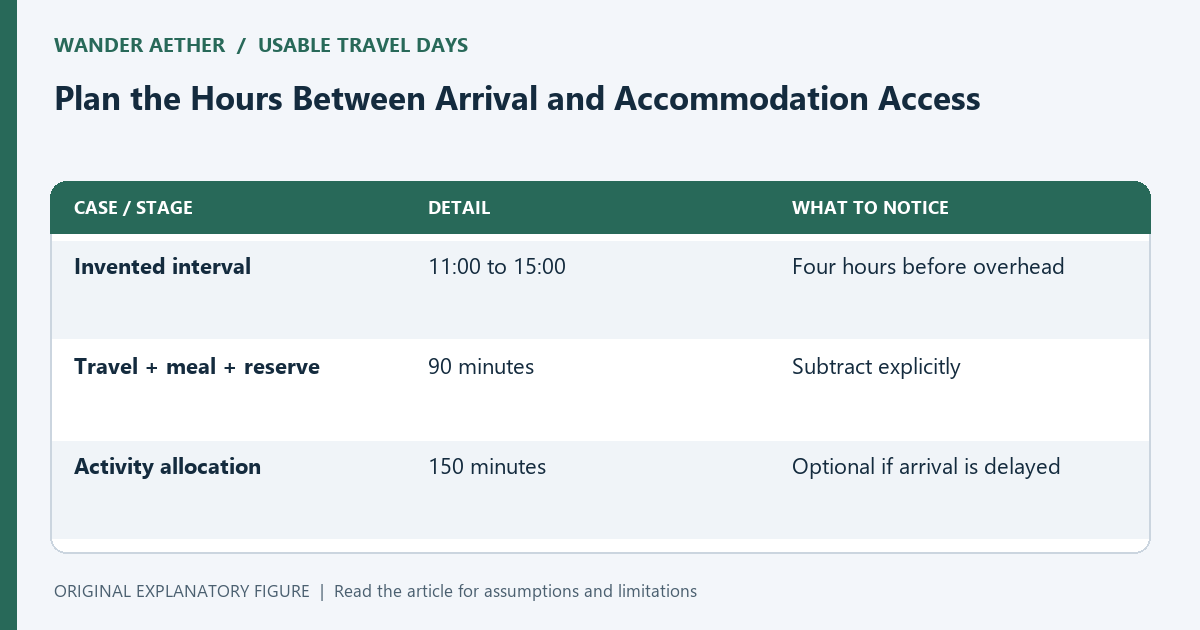
In an invented example, arrival is 10:00, access and luggage handling finish at 11:00, and the return for accommodation access is 15:00. That creates a four-hour interval before subtracting travel, meals, and reserve.
If those consume ninety minutes, the activity allocation is two and a half hours. The arithmetic keeps the overhead visible. These timings are not recommendations for a particular airport, station, or destination.
Choose a reversible first-day activity
Select an activity that fits the remaining interval and can be shortened if arrival runs late. Keep its location close enough to the luggage and accommodation sequence that you are not creating another large transfer.
For a real venue, verify current opening hours and reservation requirements. Do not treat a generic planning window as confirmation that a specific attraction is available. Mark the activity optional when its completion depends on the arrival going as planned.
Keep two arrival branches
Write a normal-arrival branch and a delayed-arrival branch. The delayed branch can skip the optional activity and prioritize meals, luggage, and access. Both branches should preserve confirmed commitments.
Use the itinerary tool to allocate the stages and the packing list for the first-day essentials. The useful result is a plan that works without early room access, with the favorable alternative available if confirmed. That is more dependable than counting every hour after arrival as activity time.
| Case or stage | Detail | What to notice |
|---|---|---|
| Invented interval | 11:00 to 15:00 | Four hours before overhead |
| Travel + meal + reserve | 90 minutes | Subtract explicitly |
| Activity allocation | 150 minutes | Optional if arrival is delayed |