A fee percentage tells you little unless you know the amount to which it applies and whether it is deducted from your exchange or charged on top. The currency converter uses a simple received-amount model: convert the source amount at the entered rate, then deduct the percentage fee from that converted gross amount. This guide explains that model and its limits so you can compare it with a provider's actual quote.
Worked comparison
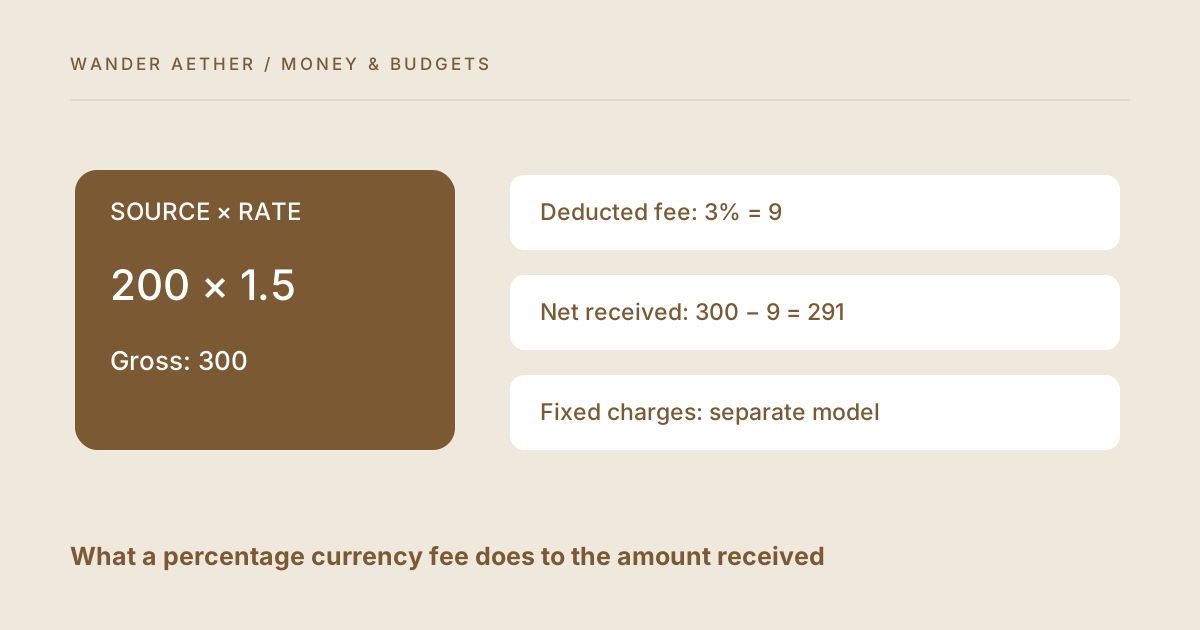
Worked example: A hypothetical exchange converts 200 source units at a rate of 1.5. Gross is 300 destination units. With a 3% deducted fee, the tool shows a fee of 9 and a net amount of 291. Another provider instead asks for 200 source units to exchange plus a 6-unit source charge. That second transaction has a total source outlay of 206 and cannot be compared with the first simply by looking at 300 versus 291. If the traveler's total budget is only 200 source units, the exchangeable amount must be reduced before calculating the second provider's received amount.
Read the three output numbers together
Gross is the source amount multiplied by the manual rate. The modelled fee is gross multiplied by the percentage divided by one hundred. Net is gross minus that fee. Displaying all three makes the assumption inspectable. A provider that charges a fee on top of the source amount can create a different total source outlay even when the destination amount resembles this result. Compare both what you pay and what you receive. Do not focus only on the net line without checking that the charging convention matches the transaction you are planning.
For the next input check, use Manual Currency Converter. Its result should retain the assumptions described here.
Distinguish a fee from a rate spread
A provider can offer a less favorable exchange rate without listing a separate percentage charge. That rate difference is not automatically included in the fee field. If you enter the provider's executable rate, the gross already reflects that rate. Entering an additional guessed spread as a fee could count the same pricing effect twice. If you instead use a reference rate for comparison, explain that reference and compare the resulting gross with the actual quote. The tool does not know which kind of rate you supplied and cannot identify hidden pricing on its own.
Handle fixed charges outside this interface
A flat processing charge, minimum fee or tiered fee cannot be represented accurately by one constant percentage for every amount. For a single transaction you can compute its final amount separately, but do not then reuse an equivalent percentage for other amounts without recalculating it. A fixed charge has a larger proportional effect on smaller transactions. Provider minimums and rounding rules also matter. The converter intentionally keeps its fee model narrow rather than pretending one field can capture every card, bank, cash desk and transfer-service pricing arrangement.
A related planning question is covered in Splitting shared trip expenses with a cents-safe ledger.
Compare equal source budgets
For a meaningful provider comparison, decide whether the source amount is the amount exchanged or the entire amount you can spend including fees. Keep that decision identical across quotes. If one provider adds charges to the source side and another deducts them from the destination side, first rewrite both into total source outlay and destination received. Then compare the same budget. This is a planning comparison, not a recommendation of a financial provider. Use the terms and final quote supplied for the particular transaction before committing money.
A same-budget comparison in numbers
Take two hypothetical quotes and require a total source outlay of exactly 200 units for each. Provider A exchanges all 200 at 1.5 and deducts 3% from the gross, yielding 291 destination units. Provider B charges a fixed 6 source units within that budget, leaving 194 to exchange. At the same illustrative rate of 1.5 and no further deduction, that yields 291 too. The headline descriptions look different but the normalized outcome matches. If B's fixed charge is paid on top instead, its outlay becomes 206 and the comparison no longer uses equal budgets. Write those assumptions beside the calculation. The converter directly models A; B requires reducing the exchange amount manually and documenting the fixed charge outside the percentage field. This small example shows why a single attractive headline rate is insufficient for a comparison. The amounts paid, amounts exchanged and amounts received must be distinguished before the arithmetic becomes meaningful. Real quotes can contain additional conditions, so check the executable terms separately.
Reference table
| Item or scenario | Value or choice | What to remember |
|---|---|---|
| Source amount | 200 | Amount entered for exchange |
| Manual rate | 1.5 | Destination units per source unit |
| Gross | 300 | 200 × 1.5 |
| Deducted fee | 9 | 300 × 3% |
| Net received | 291 | 300 − 9 |
Before you finish
- Check whether the fee is deducted or charged on top.
- Identify whether the entered rate already reflects provider pricing.
- Separate fixed and minimum charges from a constant percentage.
- Compare quotes with the same total source budget.
- Use the final provider quote before making the transaction.
Your next step
The value of this calculator is clarity about a simple assumption. Keep the exported gross, fee and net together so another person can review the estimate. If your real quote uses a different model, adapt the arithmetic separately instead of presenting the displayed net as an exact prediction.
Continue with Currency rates: which way should the conversion go?. When your plan needs the next calculation, open Group Expense Splitter and carry over only the inputs appropriate to that tool.